Register now

To access the site, please provide the required information to verify that you are a Canadian healthcare professional and create an account. Once validated, this account can be used to log in to all myAstraZeneca websites for Canadian healthcare professionals. Please use the first and last name registered with your professional college.

Already have an account?

If you already have an IQVIA OneKey account, log in to access the myAstraZeneca websites.

Clinical trials1-10

The efficacy and safety profile of SYMBICORT TURBUHALER has been evaluated in clinical studies in asthma and COPD.

Summary: Asthma clinical trials

See the chart below to learn more about each of the following SYMBICORT TURBUHALER asthma studies.

Trial Select patient characteristics Demonstrated reduction in severe exacerbations NNT
SYGMA 11,2
  • Mild persistent asthma
  • ≥12 years of age
  • 3836 patients
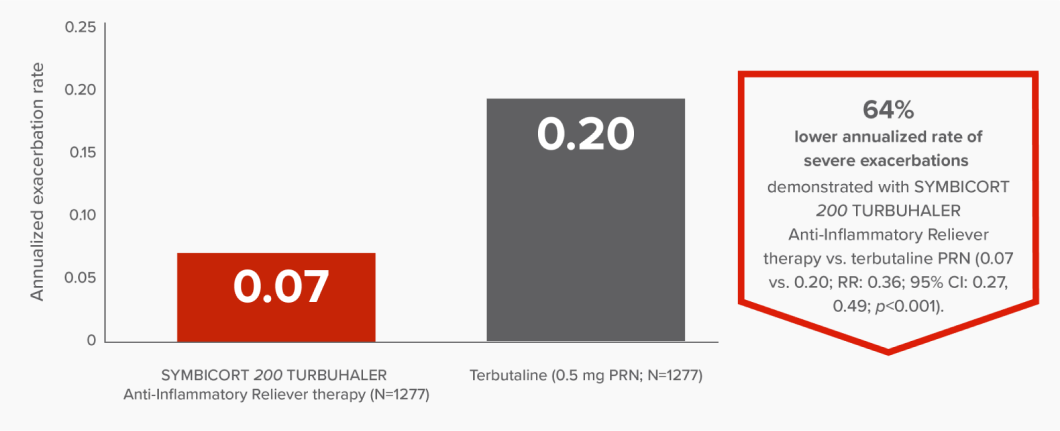
  • 64% lower annualized rate of severe exacerbations demonstrated with SYMBICORT 200 TURBUHALER Anti-Inflammatory Reliever therapy vs. terbutaline PRN (2o endpoint, 0.07 vs. 0.20; RR: 0.36; 95% CI: 0.27, 0.49; p<0.001).
  • Comparable reduction in severe exacerbation rate demonstrated with SYMBICORT 200 TURBUHALER Anti-Inflammatory Reliever therapy vs. budesonide maintenance therapy (2o endpoint, 0.07 vs. 0.09, p=0.28).
NNT = 12 (vs. terbutaline
arm)
SYGMA 21,3
  • Mild persistent asthma
  • ≥12 years of age
  • 4176 patients
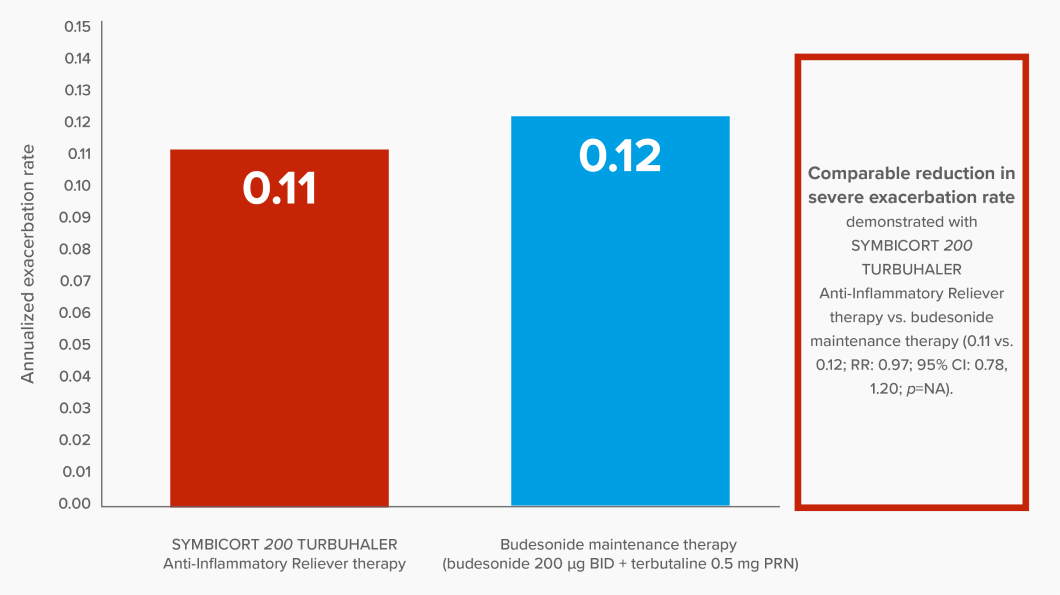
  • Reduction in severe exacerbations was non-inferior with SYMBICORT 200 TURBUHALER Anti-Inflammatory Reliever therapy vs. budesonide maintenance therapy (1o endpoint, 0.11 vs. 0.12, p=NA; RR: 0.97; 95% CI: 0.78, 1.20; upper limit of the 2-sided 95% CI<1.20 for non-inferiority).
 
SMILE1,4
  • Moderate to severe asthma
  • ≥1 severe asthma exacerbation in the past 12 months
  • Symptomatic on SYMBICORT 200 TURBUHALER one inhalation BID during a 2-week run-in
  • Using ICS ≥3 months
  • 3394 patients
  • 27% reduction in risk of severe exacerbations demonstrated with SYMBICORT 200 TURBUHALER Anti-Inflammatory Reliever plus Maintenance therapy vs. SYMBICORT 200 TURBUHALER + formoterol PRN (2o endpoint, 194 vs. 296, p=0.0038).
NNT = 12
COMPASS1,5
  • Moderate to severe asthma
  • ≥1 severe asthma exacerbation in the past 12 months
  • Using ICS ≥3 months
  • 3335 patients
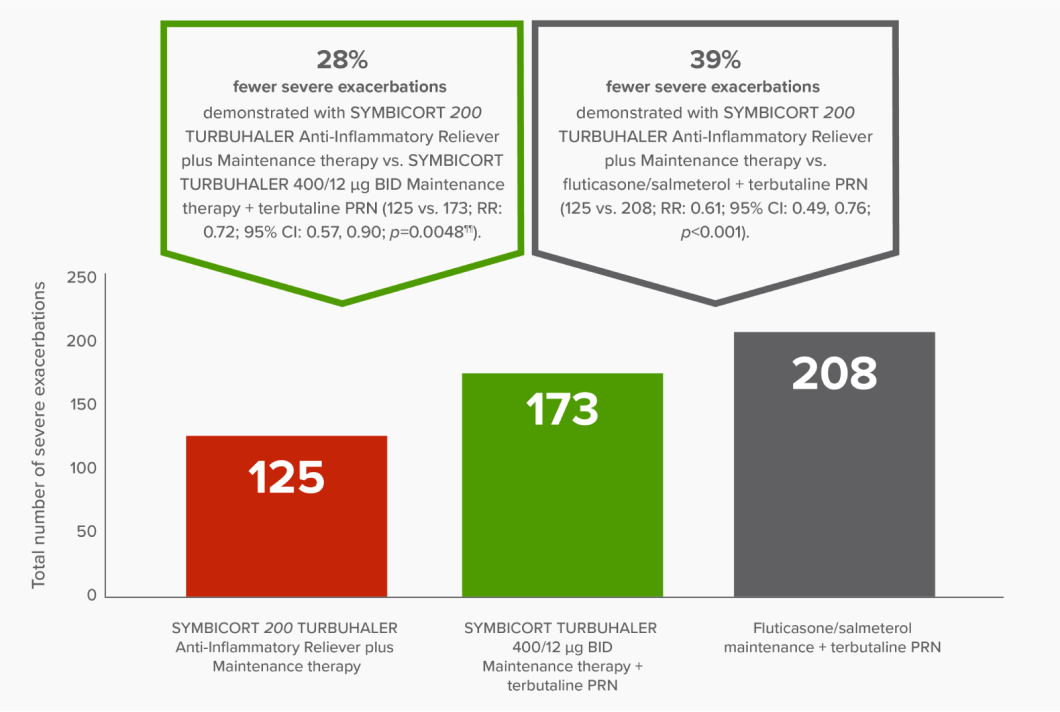
  • 39% reduction in severe exacerbations demonstrated with SYMBICORT 200 TURBUHALER Anti-Inflammatory Reliever plus Maintenance therapy vs. fluticasone/salmeterol maintenance + terbutaline PRN (2o endpoint, 125 vs. 208, p<0.001).
NNT = 14
STEP1,6*
  • Moderate to severe asthma
  • Symptomatic with ≥1 exacerbation in the past 12 months
  • Treated with 400 to 1000 µg/day of ICS for ≥3 months
  • 1890 patients
  • 39% reduction in severe exacerbations demonstrated with SYMBICORT 200 TURBUHALER Anti-Inflammatory Reliever plus Maintenance therapy vs. budesonide maintenance therapy + terbutaline PRN (2o endpoint, 197 vs. 349, p<0.001).
NNT = 7
STAY1,7†
  • Moderate to severe asthma
  • Symptomatic with ≥1 exacerbation in the past 12 months
  • Treated with 400 to 1000 µg/day of ICS (adults) for ≥3 months
  • 2760 patients
  • 50% reduction in risk of severe exacerbations demonstrated with SYMBICORT 100 TURBUHALER Anti-Inflammatory Reliever plus Maintenance therapy vs. SYMBICORT 100 TURBUHALER + terbutaline PRN (2o endpoint, 160 vs. 330, p<0.001).
NNT = 6
STEAM1,8‡
  • Mild to moderate asthma
  • Symptomatic with ≥7 inhalations of as-needed medication during the last 10 days of the run-in period but <10 inhalations on any single day
  • Treated with budesonide (100 µg BID) and inhaled terbutaline (0.5 mg) PRN for 14 to 18 days (run-in period)
  • 697 patients
  • This study was conducted in patients with mild-to-moderate asthma. SYMBICORT 100 TURBUHALER Anti-Inflammatory Reliever plus Maintenance therapy is only indicated in patients with moderate or severe asthma.
  • 70% reduction in severe exacerbations demonstrated with SYMBICORT 100 TURBUHALER Anti-Inflammatory Reliever Plus Maintenance therapy vs. budesonide maintenance + terbutaline PRN (2o endpoint, 14 vs. 57, p<0.001).
NNT = 8

Trial

Select patient characteristics

  • Mild persistent asthma
  • ≥12 years of age
  • 3836 patients

Demonstrated reduction in severe exacerbations

  • 64% lower annualized rate of severe exacerbations demonstrated with SYMBICORT 200 TURBUHALER Anti-Inflammatory Reliever therapy vs. terbutaline PRN (2o endpoint, 0.07 vs. 0.20; RR: 0.36; 95% CI: 0.27, 0.49; p<0.001).
  • Comparable reduction in severe exacerbation rate demonstrated with SYMBICORT 200 TURBUHALER Anti-Inflammatory Reliever therapy vs. budesonide maintenance therapy (2o endpoint, 0.07 vs. 0.09, p=0.28).

NNT

NNT = 12
(vs. terbutaline arm)

Select patient characteristics

  • Mild persistent asthma
  • ≥12 years of age
  • 4176 patients

Demonstrated reduction in severe exacerbations

  • Reduction in severe exacerbations was non-inferior with SYMBICORT 200 TURBUHALER Anti-Inflammatory Reliever therapy vs. budesonide maintenance therapy (1o endpoint, 0.11 vs. 0.12, p=NA; RR: 0.97; 95% CI: 0.78, 1.20; upper limit of the 2-sided 95% CI<1.20 for non-inferiority).

NNT

No Data

Select patient characteristics

  • Moderate to severe asthma
  • ≥1 severe asthma exacerbation in the past 12 months
  • Symptomatic on SYMBICORT 200 TURBUHALER one inhalation BID during a 2-week run-in
  • Using ICS ≥3 months
  • 3394 patients

Demonstrated reduction in severe exacerbations

  • 27% reduction in risk of severe exacerbations demonstrated with SYMBICORT 200 TURBUHALER Anti-Inflammatory Reliever plus Maintenance therapy vs. SYMBICORT 200 TURBUHALER + formoterol PRN (2o endpoint, 194 vs. 296, p=0.0038).

NNT

NNT = 12

Select patient characteristics

  • Moderate to severe asthma
  • ≥1 severe asthma exacerbation in the past 12 months
  • Using ICS ≥3 months
  • 3335 patients

Demonstrated reduction in severe exacerbations

  • 39% reduction in severe exacerbations demonstrated with SYMBICORT 200 TURBUHALER Anti-Inflammatory Reliever plus Maintenance therapy vs. fluticasone/salmeterol maintenance + terbutaline PRN (2o endpoint, 125 vs. 208, p<0.001).

NNT

NNT = 14

Select patient characteristics

  • Moderate to severe asthma
  • Symptomatic with ≥1 exacerbation in the past 12 months
  • Treated with 400 to 1000 µg/day of ICS for ≥3 months
  • 1890 patients

Demonstrated reduction in severe exacerbations

  • 39% reduction in severe exacerbations demonstrated with SYMBICORT 200 TURBUHALER Anti-Inflammatory Reliever plus Maintenance therapy vs. budesonide maintenance therapy + terbutaline PRN (2o endpoint, 197 vs. 349, p<0.001).

NNT

NNT = 7

Select patient characteristics

  • Moderate to severe asthma
  • Symptomatic with ≥1 exacerbation in the past 12 months
  • Treated with 400 to 1000 µg/day of ICS (adults) for ≥3 months
  • 2760 patients

Demonstrated reduction in severe exacerbations

  • 50% reduction in risk of severe exacerbations demonstrated with SYMBICORT 100 TURBUHALER Anti-Inflammatory Reliever plus Maintenance therapy vs. SYMBICORT 100 TURBUHALER + terbutaline PRN (2o endpoint, 160 vs. 330, p<0.001).

NNT

NNT = 6

Select patient characteristics

  • Mild to moderate asthma
  • Symptomatic with ≥7 inhalations of as-needed medication during the last 10 days of the run-in period but <10 inhalations on any single day
  • Treated with budesonide (100 µg BID) and inhaled terbutaline (0.5 mg) PRN for 14 to 18 days (run-in period)
  • 697 patients
  • This study was conducted in patients with mild-to-moderate asthma. SYMBICORT 100 TURBUHALER Anti-Inflammatory Reliever plus Maintenance therapy is only indicated in patients with moderate or severe asthma.

Demonstrated reduction in severe exacerbations

  • 70% reduction in severe exacerbations demonstrated with SYMBICORT 100 TURBUHALER Anti-Inflammatory Reliever plus Maintenance therapy vs. budesonide maintenance + terbutaline PRN (2o endpoint, 14 vs. 57, p<0.001).

NNT

NNT = 8

Summary: COPD clinical trials

See the chart below to learn more about each of the following SYMBICORT TURBUHALER COPD studies.

Trial Study characteristics Demonstrated reduction in severe exacerbations
Szafranski study1,9
  • Moderate to severe COPD
  • ≥1 severe COPD exacerbation within 2-12 months before first clinic visit
  • Documented use of short-acting inhaled bronchodilators for reliever medication
  • 812 patients
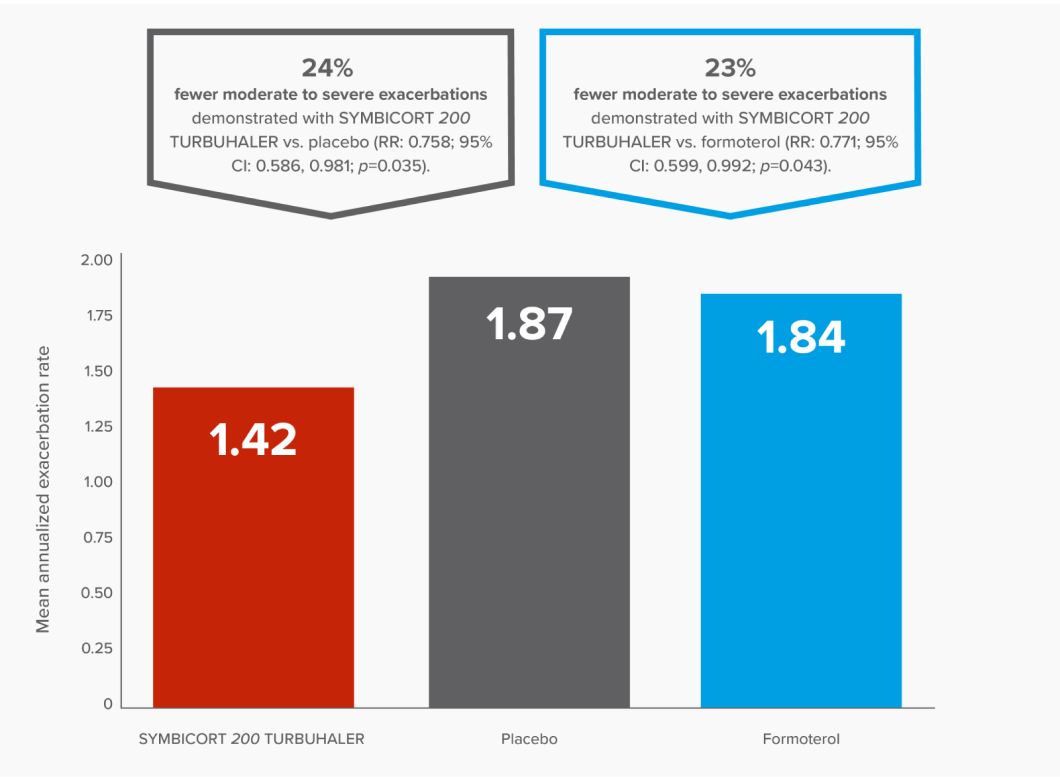
  • 23% reduction in moderate to severe exacerbation
    demonstrated with SYMBICORT 200 TURBUHALER vs. formoterol (co-primary endpoint, 1.42 vs. 1.84, p=0.043).
Calverley study1,10
  • Moderate to severe COPD
  • ≥1 COPD exacerbation requiring a course of oral corticosteroids and/or antibiotics before first clinic visit
  • Documented use of short-acting inhaled bronchodilators for reliever medication
  • 1012 patients
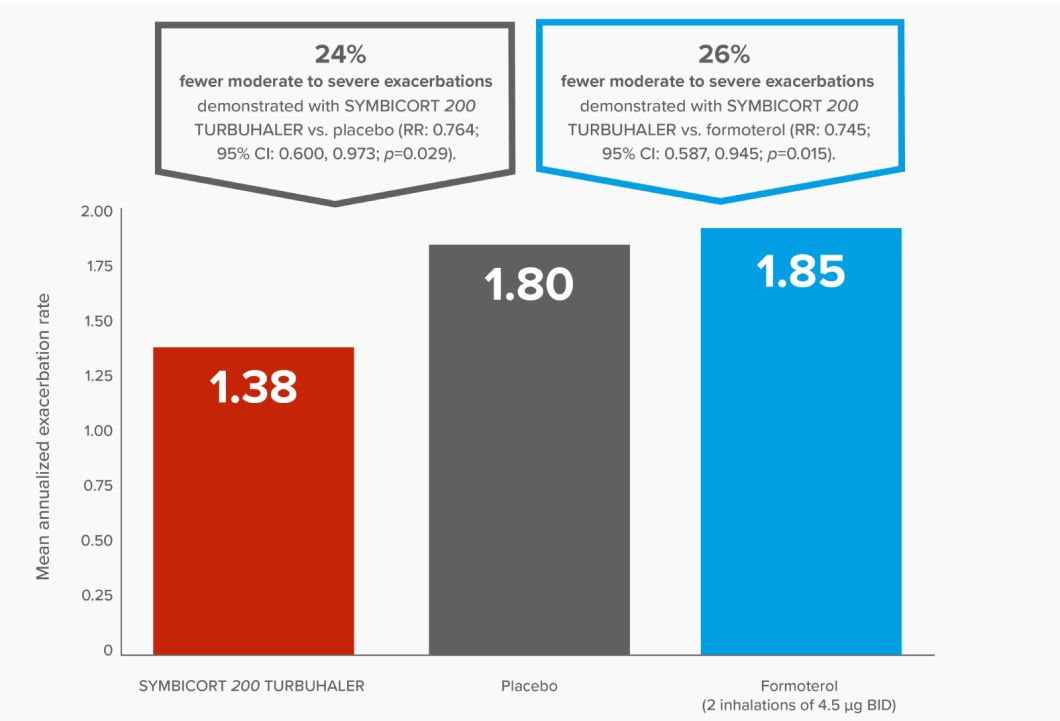
  • 26% reduction in moderate to severe exacerbation
    demonstrated with SYMBICORT 200 TURBUHALER vs. formoterol (co-primary endpoint, 1.38 vs. 1.85, p=0.015).

Trial

Select patient characteristics

  • Moderate to severe COPD
  • ≥1 severe COPD exacerbation within 2-12 months before first clinic visit
  • Documented use of short-acting inhaled bronchodilators for reliever medication
  • 812 patients

Demonstrated reduction in severe exacerbations

  • 23% reduction in moderate to severe exacerbation demonstrated with SYMBICORT 200 TURBUHALER vs. formoterol
    (co-primary endpoint, 1.42 vs. 1.84, p=0.043).

Study characteristics

  • Moderate to severe COPD
  • ≥1 COPD exacerbation requiring a course of oral corticosteroids and/or antibiotics before first clinic visit
  • Documented use of short-acting inhaled bronchodilators for reliever medication
  • 1012 patients

Demonstrated reduction in severe exacerbations

  • 26% reduction in moderate to severe exacerbation demonstrated with SYMBICORT 200 TURBUHALER vs. formoterol
    (co-primary endpoint, 1.38 vs. 1.85, p=0.015).

SYMBICORT TURBUHALER asthma clinical trials

Mild persistent asthma

SYGMA 1 asthma clinical trial1,2

The SYMBICORT TURBUHALER (budesonide/formoterol) SYGMA 1 study was a randomized, double-blind, parallel group, 52-week study comparing SYMBICORT 200 TURBUHALER Anti-Inflammatory Reliever therapy to terbutaline (0.5 mg PRN) or budesonide maintenance therapy (budesonide 200 µg BID + terbutaline 0.5 mg PRN) in patients with mild persistent asthma (N=3836 patients).

SYGMA 1 clinical trial results

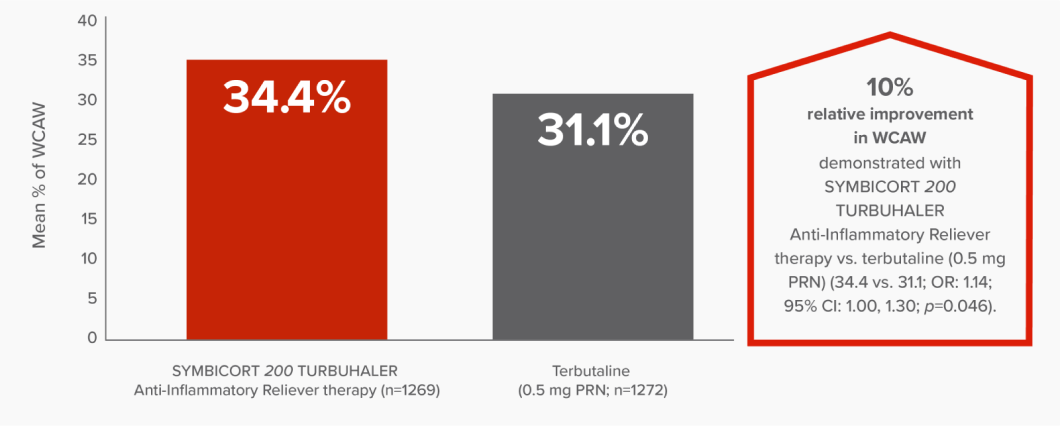
SYMBICORT 200 TURBUHALER Anti-Inflammatory Reliever therapy significantly increased the mean percentage of WCAW vs. terbutaline over the 52-week treatment period (1o endpoint)

Bar graph showing a 10% relative improvement in WCAW demonstrated with SYMBICORT 200 TURBUHALER Anti-Inflammatory Reliever therapy vs. terbutaline (0.5 mg PRN) (34.4% vs. 31.1%; OR: 1.14; 95% CI: 1.00, 1.30; p=0.046).

Adapted from O'Byrne et al.

Secondary analysis of the primary endpoint (in terms of WCAW) showed that non-inferiority for asthma symptom control was not met for SYMBICORT 200 TURBUHALER Anti-Inflammatory Reliever therapy vs. budesonide maintenance therapy (OR: 0.64; 95% CI: 0.57, 0.73; p=NA).§

SYMBICORT 200 TURBUHALER Anti-Inflammatory Reliever therapy significantly reduced the rate of annual severe exacerbation** vs. terbutaline (2o endpoint)

Bar graph showing that there was a 64% lower annualized rate of severe exacerbations demonstrated with SYMBICORT 200 TURBUHALER Anti-Inflammatory Reliever therapy vs. terbutaline PRN (annualized exacerbation rate: 0.07 vs. 0.20; RR: 0.36; 95% CI: 0.27, 0.49; p<0.001).

Adapted from O'Byrne et al.

NNT=12 reduce 1 severe exacerbation for every 12 patients treated for 1 year with SYMBICORT TURBUHALER vs. terbutaline PRN.

The rate of annual severe exacerbation was 0.07 for SYMBICORT 200 TURBUHALER Anti-Inflammatory Reliever therapy and 0.09 for budesonide maintenance therapy (RR: 0.83; 95% CI: 0.59, 1.16; p=0.28).

60% reduction demonstrated in the annual rate of moderate-to-severe exacerbations with SYMBICORT 200 TURBUHALER Anti-Inflammatory Reliever therapy vs. terbutaline PRN (2o endpoint; 0.14 vs. 0.36; RR: 0.40; 95% CI: 0.32, 0.49).

  • Consistent with reduction in annual rate of severe exacerbations.

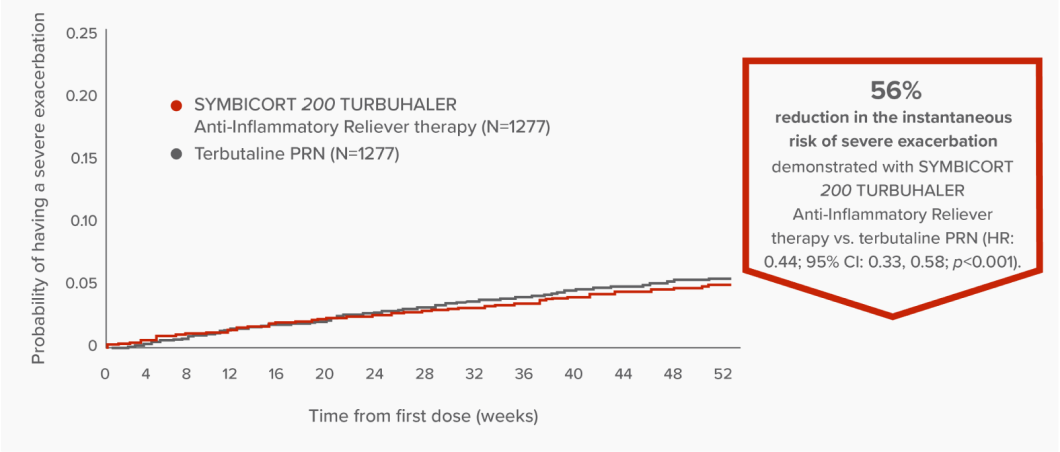
SYMBICORT 200 TURBUHALER Anti-Inflammatory Reliever therapy significantly prolonged time to first severe exacerbation** over the 52-week treatment period vs. terbutaline PRN (2o endpoint)

Line graph showing that there was a 56% reduction in the instantaneous risk of severe exacerbation demonstrated with SYMBICORT 200 TURBUHALER Anti-Inflammatory Reliever therapy vs. terbutaline PRN (HR: 0.44; 95% CI: 0.33, 0.58; p<0.001).

Adapted from the SYMBICORT TURBUHALER Product Monograph and O'Byrne et al.

The results for time to first severe exacerbation did not differ significantly between SYMBICORT 200 TURBUHALER and budesonide maintenance therapy (HR: 0.90; 95% CI: 0.65, 1.24; p=0.52).

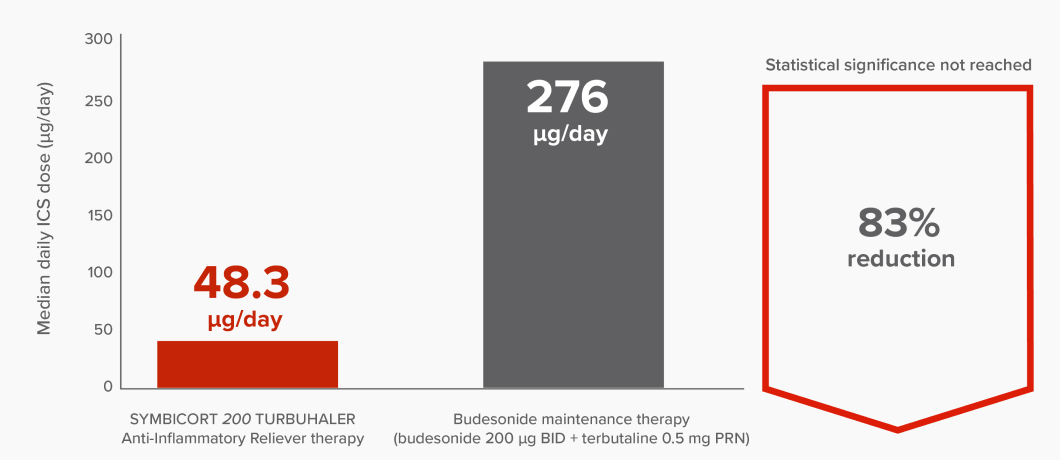
SYMBICORT 200 TURBUHALER Anti-Inflammatory Reliever therapy achieved comparable reduction in severe** and moderate-to-severe exacerbations while reducing the median ICS load compared to budesonide maintenance therapy (2o endpoint)

Bar graph showing an 83% reduction in median daily ICS dose with SYMBICORT 200 TURBUHALER Anti-Inflammatory Reliever therapy vs. Budesonide maintenance therapy (48.3 µg/day vs. 276 µg/day. Statistical significance was not reached).

Adapted from the SYMBICORT TURBUHALER Product Monograph.

Other secondary endpoints included medication usage, lung function variables, asthma control, and quality of life.

For more information on SYGMA 1 secondary endpoints, please refer to the Symbicort Turbuhaler Product Monograph.

Mild persistent asthma

SYGMA 2 asthma clinical trial1,3

The SYMBICORT TURBUHALER (budesonide/formoterol) SYGMA 2 study was a randomized, double-blind, parallel-group, 52-week study comparing SYMBICORT 200 TURBUHALER Anti-Inflammatory Reliever therapy (placebo BID + SYMBICORT 200 TURBUHALER PRN) to budesonide maintenance therapy (budesonide 200 µg BID + terbutaline 0.5 mg PRN) in patients with mild persistent asthma (N=4176 patients).

SYGMA 2 clinical trial results

SYMBICORT 200 TURBUHALER Anti-Inflammatory Reliever therapy achieved a comparable reduction in severe exacerbation** rate vs. budesonide maintenance therapy over the 52-week treatment period (1o endpoint)††

Bar graph showing that there was a comparable reduction in severe exacerbation rate demonstrated with SYMBICORT 200 TURBUHALER Anti-Inflammatory Reliever therapy vs. budesonide maintenance therapy (annualized exacerbation rate: 0.11 vs. 0.12; RR: 0.97; 95% CI: 0.78, 1.20; p=NA).

Adapted from Bateman et al.

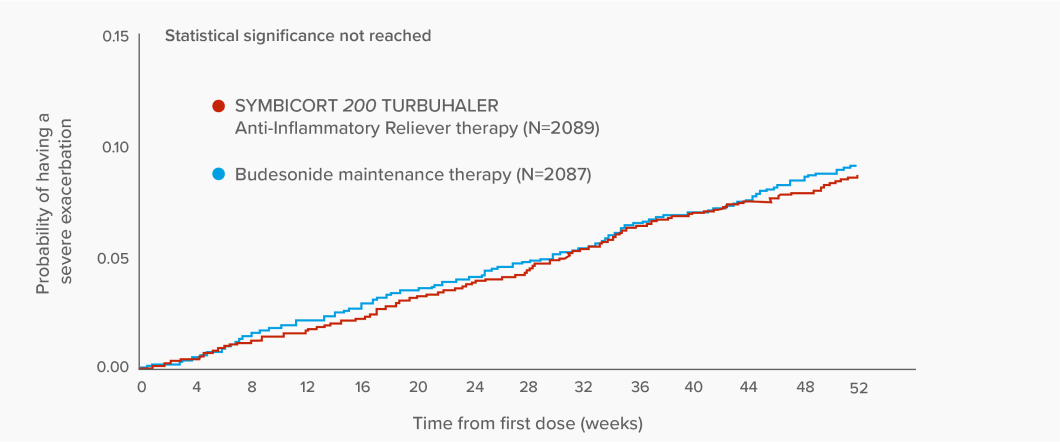
There were no significant differences in the time to first severe exacerbation** between SYMBICORT 200 TURBUHALER Anti-Inflammatory Reliever therapy and budesonide maintenance therapy (2o endpoint)

Line graph showing that there were no significant differences in the time to first severe exacerbation between SYMBICORT 200 TURBUHALER Anti-Inflammatory Reliever therapy and budesonide maintenance therapy.

Adapted from the SYMBICORT TURBUHALER Product Monograph and Bateman et al.

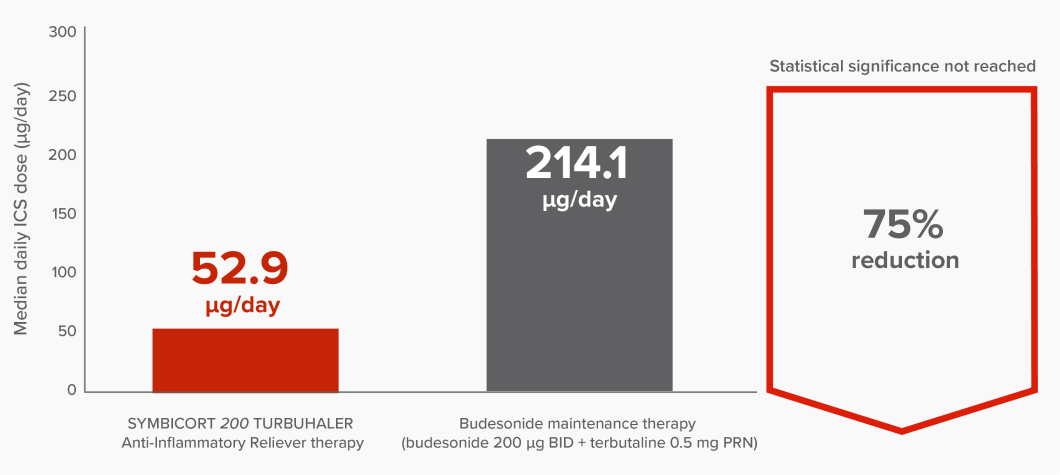
SYMBICORT 200 TURBUHALER Anti-Inflammatory Reliever therapy achieved comparable reduction in severe** and moderate-to-severe exacerbations while reducing the median ICS load compared to budesonide maintenance therapy (2o endpoint)

Bar graph showing a 75% reduction in median daily ICS dose with SYMBICORT 200 TURBUHALER Anti-Inflammatory Reliever therapy vs. Budesonide maintenance therapy (52.9 µg/day vs. 214.1 µg/day. Statistical significance was not reached).

Adapted from the SYMBICORT TURBUHALER Product Monograph.

Other secondary endpoints included medication usage, lung function variables, asthma control, and quality of life.

For more information on SYGMA 2 secondary endpoints, please refer to the Symbicort Turbuhaler Product Monograph.

Moderate to severe asthma

SMILE asthma clinical trial1,4

The SYMBICORT TURBUHALER (budesonide/formoterol) SMILE study was a randomized, double-blind, parallel-group, 12-month study comparing SYMBICORT 200 TURBUHALER Anti-Inflammatory Reliever plus Maintenance therapy (SYMBICORT 200 TURBUHALER 1 inhalation BID + SYMBICORT 200 TURBUHALER PRN) to SYMBICORT TURBUHALER Maintenance therapy (SYMBICORT 200 TURBUHALER 1 inhalation BID) + terbutaline (0.5 mg PRN) or formoterol (6 µg PRN) in patients with moderate to severe asthma (N=3394 patients).

SMILE clinical trial results

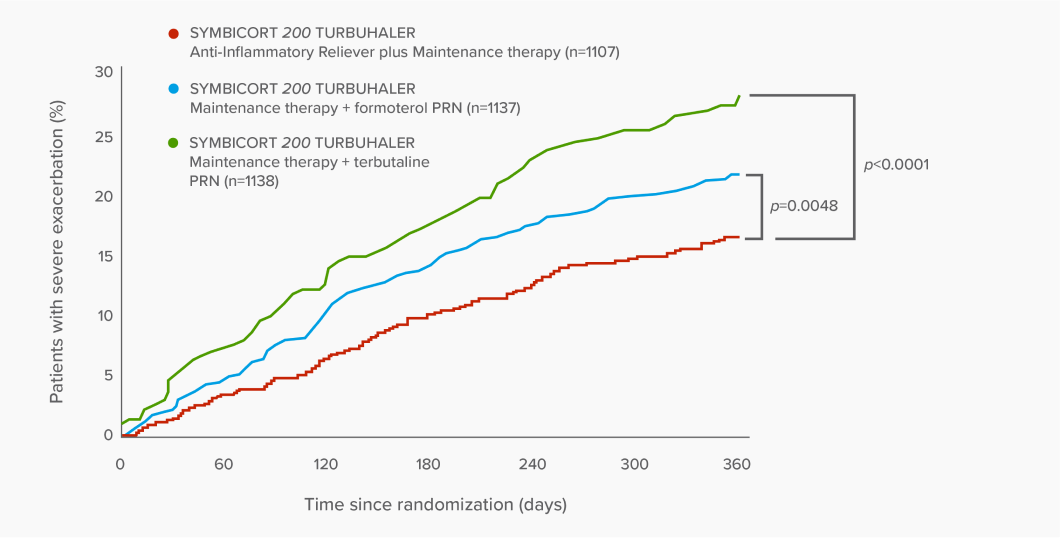
SYMBICORT 200 TURBUHALER Anti-Inflammatory Reliever plus Maintenance therapy significantly prolonged time to first severe exacerbation‡‡ vs. SYMBICORT 200 TURBUHALER maintenance + formoterol PRN and SYMBICORT 200 TURBUHALER maintenance + terbutaline PRN (1o endpoint)

Line graph showing that SYMBICORT 200 TURBUHALER Anti-Inflammatory Reliever plus Maintenance therapy significantly prolonged time to first severe exacerbation vs. SYMBICORT 200 TURBUHALER maintenance + formoterol PRN and SYMBICORT 200 TURBUHALER maintenance + terbutaline PRN (SYMBICORT 200 TURBUHALER Anti-Inflammatory Reliever + Maintenance therapy vs. SYMBICORT 200 TURBUHALER Maintenance therapy + formoterol, p=0.0048; SYMBICORT 200 TURBUHALER Anti-Inflammatory Reliever + Maintenance therapy vs. SYMBICORT 200 TURBUHALER Maintenance therapy + terbutaline, p<0.0001).

Adapted from Rabe et al.

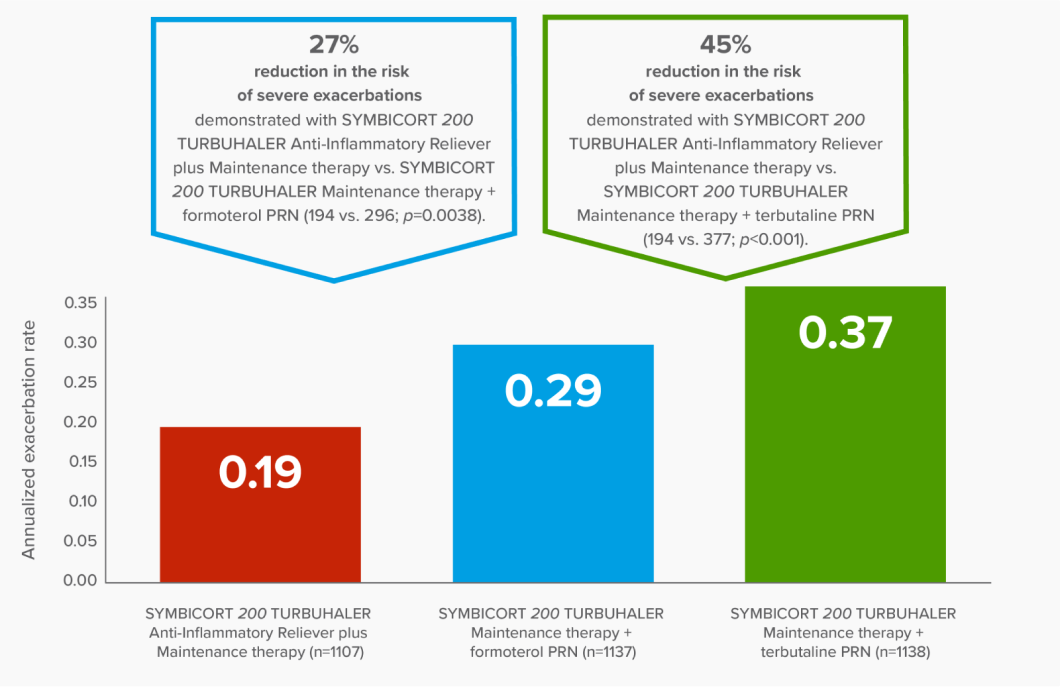
SYMBICORT 200 TURBUHALER Anti-Inflammatory Reliever plus Maintenance therapy significantly reduced severe exacerbations‡‡ vs. SYMBICORT 200 TURBUHALER Maintenance + formoterol PRN and SYMBICORT 200 TURBUHALER Maintenance + terbutaline PRN (2o endpoint)

Bar graph showing that there was a 27% reduction in the risk of severe exacerbations demonstrated with SYMBICORT 200 TURBUHALER Anti-Inflammatory Reliever plus Maintenance therapy vs. SYMBICORT 200 TURBUHALER Maintenance therapy + formoterol PRN (annualized exacerbation rate: 0.19 vs. 0.29; 194 vs. 296; p=0.0038) and a 45% reduction in the risk of severe exacerbations demonstrated with SYMBICORT 200 TURBUHALER Anti-Inflammatory Reliever plus Maintenance therapy vs. SYMBICORT 200 TURBUHALER Maintenance therapy + terbutaline PRN (annualized exacerbation rate: 0.19 vs. 0.37; 194 vs. 377; p<0.001).

Adapted from Rabe et al.

NNT=12 reduce 1 severe exacerbation for every 12 patients treated for 1 year with SYMBICORT TURBUHALER Anti-Inflammatory Reliever plus Maintenance therapy vs. SYMBICORT 200 TURBUHALER Maintenance therapy + formoterol PRN.

NNT=7 reduce 1 severe exacerbation for every 7 patients treated for 1 year with SYMBICORT TURBUHALER Anti-Inflammatory Reliever plus Maintenance therapy vs. SYMBICORT 200 TURBUHALER Maintenance therapy + terbutaline PRN.

Moderate to severe asthma

COMPASS asthma clinical trial1,5

The SYMBICORT TURBUHALER (budesonide/formoterol) COMPASS study was a randomized, double-blind, double-dummy, parallel-group, 6-month study comparing SYMBICORT 200 TURBUHALER Anti-Inflammatory Reliever plus Maintenance therapy (SYMBICORT 200 TURBUHALER 1 inhalation BID + SYMBICORT TURBUHALER PRN) to fluticasone/salmeterol maintenance + terbutaline PRN (fluticasone/salmeterol 125/25 µg 2 inhalations BID + terbutaline 0.5 mg PRN) or SYMBICORT TURBUHALER 400/12 µg BID Maintenance therapy (SYMBICORT TURBUHALER 400/12 µg 1 inhalation BID + terbutaline 0.5 mg PRN) in patients with moderate to severe asthma (N=3335 patients).

COMPASS clinical trial results

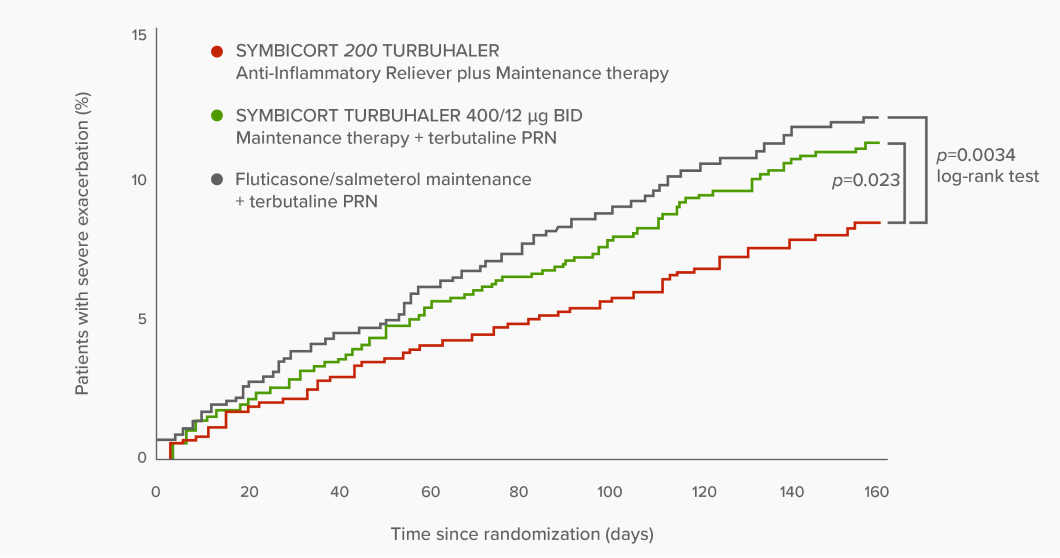
SYMBICORT 200 TURBUHALER Anti-Inflammatory Reliever plus Maintenance therapy significantly prolonged time to first severe exacerbation‡‡ vs. SYMBICORT TURBUHALER 400/12 µg BID Maintenance therapy + terbutaline and fluticasone/salmeterol maintenance + terbutaline PRN (1o endpoint)

Line graph showing that SYMBICORT 200 TURBUHALER Anti-Inflammatory Reliever plus Maintenance therapy significantly prolonged time to first severe exacerbation vs. SYMBICORT TURBUHALER 400/12 µg BID Maintenance therapy + terbutaline and fluticasone/salmeterol maintenance + terbutaline PRN (SYMBICORT 200 TURBUHALER Anti-Inflammatory Reliever + Maintenance therapy vs. SYMBICORT TURBUHALER 400/12 µg + terbutaline PRN, p=0.023; SYMBICORT 200 TURBUHALER Anti-Inflammatory Reliever + Maintenance therapy vs. fluticasone/salmeterol maintenance + terbutaline, p=0.0034) log-rank test.

Adapted from Kuna et al.

The two fixed-dose groups did not differ with respect to time to first severe exacerbation.

SYMBICORT 200 TURBUHALER Anti-Inflammatory Reliever plus Maintenance therapy significantly reduced severe exacerbations‡‡ vs. SYMBICORT TURBUHALER 400/12 µg BID Maintenance therapy + terbutaline PRN and fluticasone/salmeterol maintenance + terbutaline PRN (2o endpoint)

Bar graph showing that there were 28% fewer severe exacerbations demonstrated with SYMBICORT 200 TURBUHALER Anti-Inflammatory Reliever plus Maintenance therapy vs. SYMBICORT TURBUHALER 400/12 µg BID Maintenance therapy + terbutaline PRN (exacerbation rate/6 months: 0.12 vs. 0.16; 125 vs. 173; RR: 0.72; 95% CI: 0.57, 0.90; p=0.0048¶¶) and 39% fewer severe exacerbations demonstrated with SYMBICORT 200 TURBUHALER Anti-Inflammatory Reliever plus Maintenance therapy vs. fluticasone/salmeterol + terbutaline PRN (exacerbation rate/6 months: 0.12 vs. 0.19; 125 vs. 208; RR: 0.61; 95% CI: 0.49-0.76; p<0.001).

Adapted from Kuna et al. ¶¶ p-value based on Poisson regression.

NNT=23 reduce 1 severe exacerbation for every 23 patients treated for six months with SYMBICORT TURBUHALER Anti-Inflammatory Reliever plus Maintenance therapy vs. SYMBICORT 200 TURBUHALER Maintenance + terbutaline PRN.

NNT=14reduce 1 severe exacerbation for every 14 patients treated for six months with SYMBICORT TURBUHALER Anti-Inflammatory Reliever plus Maintenance therapy vs. fluticasone/salmeterol + terbutaline PRN.

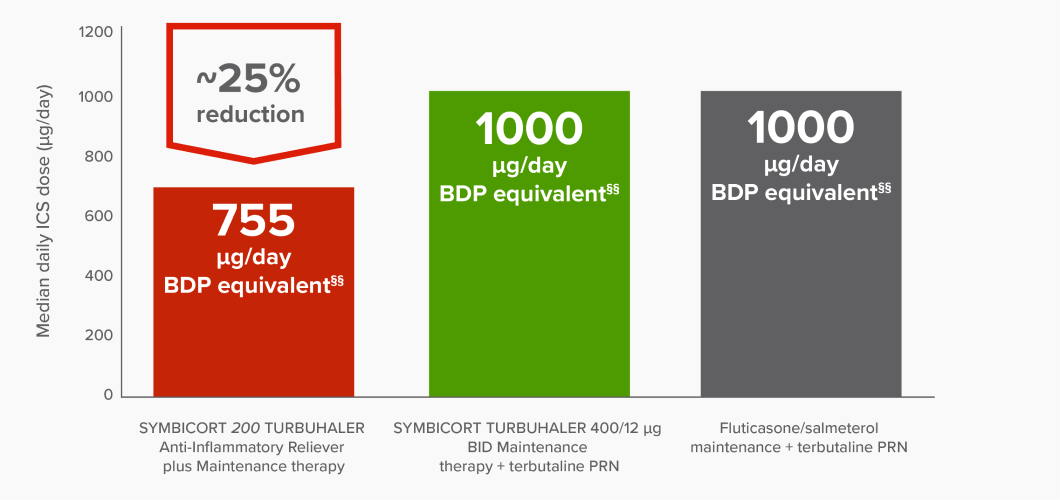
Reduced rates of severe exacerbations were achieved with a reduced ICS load with SYMBICORT 200 TURBUHALER Anti-Inflammatory Reliever plus Maintenance therapy vs. SYMBICORT TURBUHALER 400/12 µg BID Maintenance therapy + terbutaline PRN and fluticasone/salmeterol maintenance + terbutaline PRN

Bar graph showing a 25% reduction in median daily ICS dose with SYMBICORT 200 TURBUHALER Anti-Inflammatory Reliever plus Maintenance therapy (755 µg/day BDP equivalent§§) vs. SYMBICORT TURBUHALER 400/12 µg BID Maintenance therapy + terbutaline PRN (1000 µg/day BDP equivalent§§) and fluticasone/salmeterol maintenance + terbutaline PRN (1000 µg/day BDP equivalent§§).

Adapted from Kuna et al.

§§ Daily mean BDP-equivalent ICS doses (calculations based on GINA estimations of equipotence of ICS in metered doses: fluticasone 500 µg = budesonide 800 µg = beclomethasone 1000 µg).

SYMBICORT TURBUHALER COPD clinical trials

Szafranski COPD clinical trial1,9

This SYMBICORT TURBUHALER (budesonide/formoterol) trial was a randomized, double-blind, placebo-controlled, parallel-group, 12-month multicentre clinical trial comparing efficacy and safety of SYMBICORT 200 TURBUHALER (2 inhalations of 200/6 µg BID) with placebo and with the individual components (budesonide [2 inhalations of 200 µg BID] or formoterol
[2 inhalations of 6 µg BID]) in 812 adults with moderate to severe COPD.

Szafranski clinical trial results

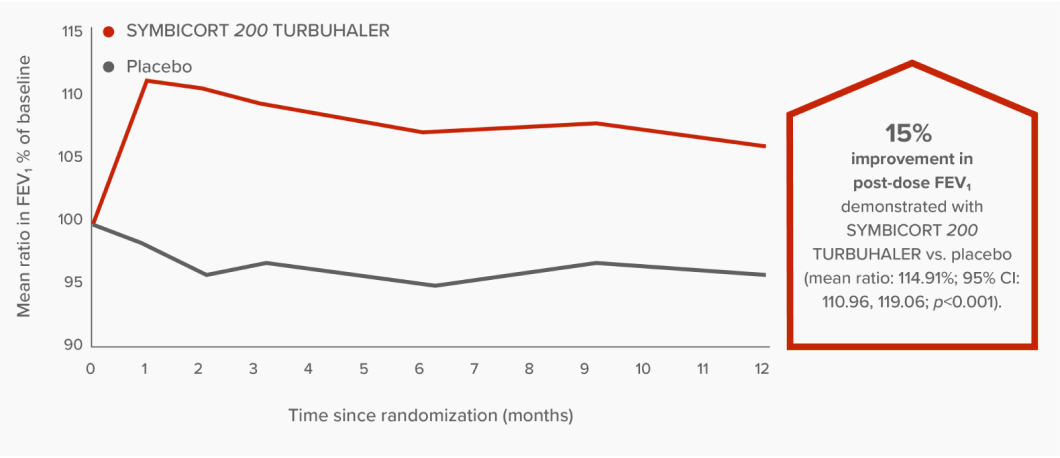
SYMBICORT 200 TURBUHALER demonstrated a significant improvement in post-bronchodilator FEV1 vs. placebo (co-primary endpoint)***

Line graph showing there was a 15% improvement in post-dose FEV1 demonstrated with SYMBICORT 200 TURBUHALER vs. placebo (mean ratio: 114.91%; 95% CI: 110.96, 119.06; p<0.001).

Adapted from Szafranski et al.

SYMBICORT 200 TURBUHALER did not statistically significantly improve post-bronchodilator FEV1 vs. formoterol
(mean ratio: 101.25%; 95% CI: 97.76, 104.86; p=0.487).


13% improvement in post-dose FEV1 demonstrated with formoterol vs. placebo (mean ratio: 113.52%; 95% CI: 109.54, 117.65; p<0.001)


This study was conducted in patients aged ≥40 with moderate to severe COPD. SYMBICORT 200 TURBUHALER Maintenance therapy is indicated in patients aged ≥18 with moderate to severe COPD.

SYMBICORT 200 TURBUHALER significantly reduced moderate to severe exacerbations††† vs. placebo and formoterol (co-primary endpoint)***

Bar graph showing that there were 24% fewer moderate to severe exacerbations demonstrated with SYMBICORT 200 TURBUHALER vs. placebo (mean annualized exacerbation rate: 1.42 vs. 1.87; RR: 0.758; 95% CI: 0.586, 0.981; p=0.035) and 23% fewer moderate to severe exacerbations demonstrated with SYMBICORT 200 TURBUHALER vs. formoterol (mean annualized exacerbation rate: 1.42 vs. 1.84; RR: 0.771; 95% CI: 0.599, 0.992; p=0.043).

Adapted from Szafranski et al.

This study was conducted in patients aged ≥40 with moderate to severe COPD. SYMBICORT 200 TURBUHALER Maintenance therapy is indicated in patients aged ≥18 with moderate to severe COPD.

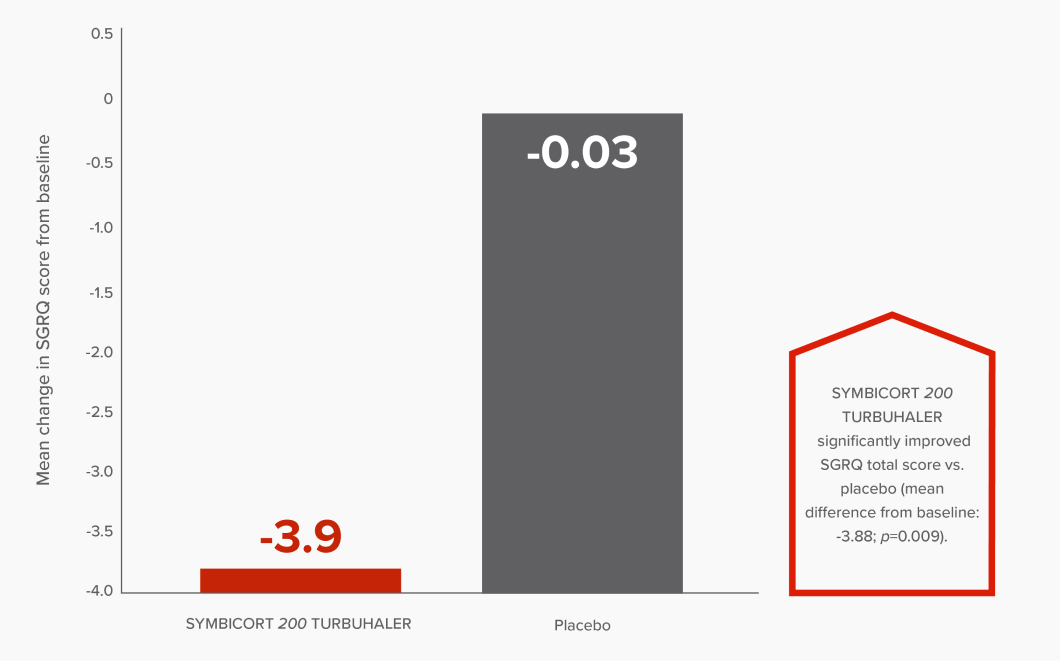
SYMBICORT 200 TURBUHALER demonstrated significant improvements in health-related quality of life (change in total SGRQ score) vs. placebo (2o endpoint)

Bar graph showing that SYMBICORT 200 TURBUHALER significantly improved SGRQ total score vs. placebo (-3.9 vs. -0.03; mean difference from baseline: -3.88; p=0.009).

Adapted from Szafranski et al.

SYMBICORT 200 TURBUHALER did not statistically significantly improve SGRQ total score vs. formoterol (mean difference from baseline: -0.34; p=0.816).


Formoterol significantly improved SGRQ total score vs. placebo (mean difference from baseline: -3.54; p=0.018).


This study was conducted in patients aged ≥40 with moderate to severe COPD. SYMBICORT 200 TURBUHALER Maintenance therapy is indicated in patients aged ≥18 with moderate to severe COPD.

SYMBICORT 200 TURBUHALER demonstrated statistically significant improvements compared to placebo for the following variables:

Peak flow meter icon

Morning and evening PEF

Night-time icon

Night-time awakenings due toCOPD symptoms

Peak clipboard icon

Total COPD symptoms scores

Inhaler icon

Use of short-acting beta2-agonists

Peak flow meter icon

Morning and evening PEF

Peak clipboard icon

Total COPD symptoms scores

Night-time icon

Night-time awakenings due toCOPD symptoms

Inhaler icon

Use of short-acting beta2-agonists

Calverley COPD clinical trial1,10

This SYMBICORT TURBUHALER (budesonide/formoterol) trial was a randomized, double-blind, placebo-controlled, parallel-group, 12-month multicentre clinical trial comparing efficacy and safety of SYMBICORT 200 TURBUHALER (2 inhalations of 200/6 µg BID) with placebo and with the individual components (budesonide [2 inhalations of 200 µg BID] or formoterol [2 inhalations of 6 µg BID]) in 1012 patients.

Calverley clinical trial results

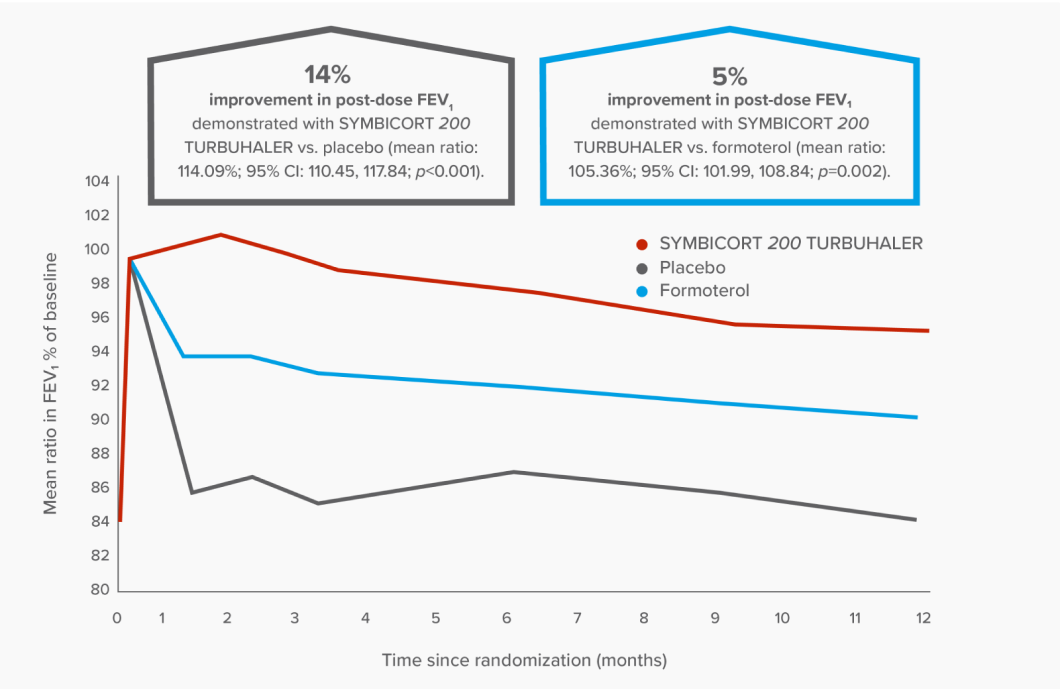
SYMBICORT 200 TURBUHALER demonstrated a significant improvement in post-bronchodilator FEV1 vs. placebo and formoterol (co-primary endpoint)***

Line graph showing there was a 14% improvement in post-dose FEV1 demonstrated with SYMBICORT 200 TURBUHALER vs. placebo (mean ratio: 114.91%; 95% CI: 110.96, 119.06; p<0.001) and a 5% improvement in post-dose FEV1 demonstrated with SYMBICORT 200 TURBUHALER vs. formoterol (mean ratio: 105.36%; 95% CI: 101.99, 108.84; p=0.002).

Adapted from Calverley et al.

This study was conducted in patients aged ≥40 with moderate to severe COPD. SYMBICORT 200 TURBUHALER Maintenance therapy is indicated in patients aged ≥18 with moderate to severe COPD.

SYMBICORT 200 TURBUHALER significantly reduced moderate to severe exacerbations††† vs. placebo and formoterol (co-primary endpoint)***

Bar graph showing that there were 24% fewer moderate to severe exacerbations demonstrated with SYMBICORT 200 TURBUHALER vs. placebo (mean annualized exacerbation rate: 1.38 vs. 1.80; RR: 0.764; 95% CI: 0.600, 0.973; p=0.029) and 26% fewer moderate to severe exacerbations demonstrated with SYMBICORT 200 TURBUHALER vs. formoterol (mean annualized exacerbation rate: 1.38 vs. 1.85; RR: 0.745; 95% CI: 0.587, 0.945; p=0.015).

Adapted from Calverley et al.

This study was conducted in patients aged ≥40 with moderate to severe COPD. SYMBICORT 200 TURBUHALER Maintenance therapy is indicated in patients aged ≥18 with moderate to severe COPD.

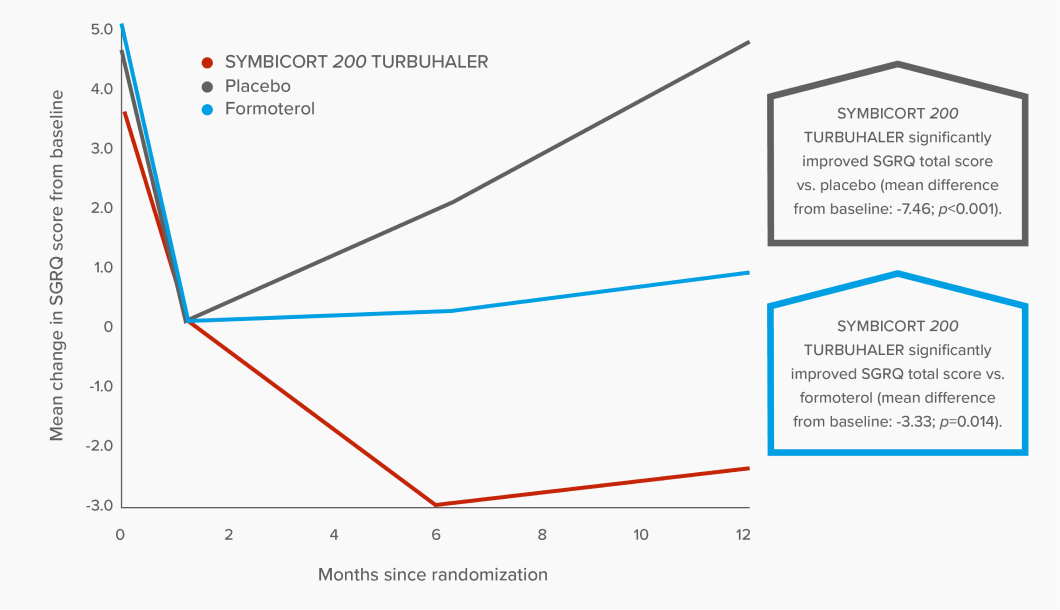
SYMBICORT 200 TURBUHALER demonstrated significant improvements in health-related quality of life (change in total SGRQ score) vs. placebo and formoterol (20 endpoint)

Line graph showing that SYMBICORT 200 TURBUHALER significantly improved SGRQ total score vs. placebo (mean difference from baseline: -7.46; p<0.001) and vs. formoterol (mean difference from baseline: -3.33; p=0.014).

Adapted from Calverley et al.

This study was conducted in patients aged ≥40 with moderate to severe COPD. SYMBICORT 200 TURBUHALER Maintenance therapy is indicated in patients aged ≥18 with moderate to severe COPD.

SYMBICORT 200 TURBUHALER demonstrated statistically significant improvements compared to placebo for the following variables:

Peak flow meter icon

Morning and evening PEF

Night-time icon

Night-time awakenings due toCOPD symptoms

Clipboard icon

Total COPD symptoms scores

Inhaler icon

Use of short-acting beta2-agonists

Peak flow meter icon

Morning and evening PEF

Clipboard icon

Total COPD symptoms scores

Night-time icon

Night-time awakenings due toCOPD symptoms

Inhaler icon

Use of short-acting beta2-agonists

BDP: beclomethasone dipropionate; BID; twice daily; CI: confidence interval; COPD: chronic obstructive pulmonary disease; FEV1: forced expiratory volume in one second; HR: hazard ratio; ICS: inhaled corticosteroid; NA: not applicable; NNT: number needed to treat; OR: odds ratio; PEF: peak expiratory flow; PRN: as needed; QD: once daily; RR: rate ratio; SGRQ: St. George’s Respiratory Questionnaire; WCAW: well-controlled asthma weeks.

* STEP: Randomized, double-blind, double-dummy, active-controlled, parallel-group, multicentre, 12-month study that compared SYMBICORT 200 TURBUHALER Anti-Inflammatory Reliever plus Maintenance therapy (SYMBICORT 200 TURBUHALER 2 inhalations QD + SYMBICORT 200 TURBUHALER PRN) to budesonide maintenance therapy (budesonide 160 µg 2 inhalations BID + terbutaline 0.5 mg PRN) (N=1890 patients). A severe exacerbation was defined as hospitalization or emergency department treatment, use of systemic steroids due to asthma worsening, or a fall in morning PEF to ≤70% of baseline on 2 consecutive days.

† STAY: Randomized, double-blind, parallel-group, multicentre, 12-month study that compared SYMBICORT 100 TURBUHALER Anti-Inflammatory Reliever plus Maintenance therapy (SYMBICORT 100 TURBUHALER 1 inhalation BID + SYMBICORT 100 TURBUHALER PRN) to SYMBICORT 100 TURBUHALER Maintenance therapy (SYMBICORT 100 TURBUHALER 1 inhalation BID + terbutaline 0.5 mg PRN) and budesonide maintenance therapy (budesonide 320 µg BID + terbutaline 0.5 mg PRN) in patients with moderate to severe asthma aged 4 to 79 years (N=2760 patients). A severe exacerbation was defined as deterioration in asthma resulting in morning PEF of ≤70% of baseline on 2 consecutive days, hospitalization or emergency department visit, treatment with oral steroids, or an increase in ICS via a separate inhaler and/or other additional treatment as an additional criterion for patients aged 4 – 11 years.

‡ STEAM: Randomized, double-blind, parallel-group, multicentre, 6-month study that compared SYMBICORT 100 TURBUHALER Anti-Inflammatory Reliever plus Maintenance therapy (2 inhalations QD + SYMBICORT 100 TURBUHALER PRN) to budesonide (160 µg 2 inhalations QD) plus terbutaline (0.5 mg PRN) in patients with mild-to-moderate asthma aged 11 to 79 years (N=697 patients). A severe exacerbation was defined as hospitalization or emergency department treatment, oral steroids for asthma, or a ≥30% decrease from baseline in morning PEF on 2 consecutive days.

¶ WCAW was a composite endpoint capturing asthma symptoms, night-time awakenings, lung function, use of as-needed medication, and prescription of ICS and/or systemic glucocorticosteroid treatment for asthma. WCAW had 3 possible values: well-controlled, not-well-controlled, and missing.

§ The non-inferiority margin comparing SYMBICORT 200 TURBUHALER to budesonide plus maintenance therapy was the lower limit of the 2-sided 95% CI ≥0.8.

** Severe exacerbation was defined as worsening asthma leading to the use of systemic glucocorticoids for ≥3 days, inpatient hospitalization, or an emergency department visit leading to the use of systemic glucocorticoids.

†† For the comparison of SYMBICORT 200 TURBUHALER Anti-Inflammatory Reliever plus Maintenance therapy vs. budesonide BID, an upper limit of the 2-sided 95% CI<1.20 indicates SYMBICORT 200 TURBUHALER Anti-Inflammatory Reliever plus Maintenance therapy was non-inferior to budesonide BID.

‡‡ Severe exacerbation was defined as deterioration in asthma resulting in emergency room treatment, hospitalization, or both, or the need for oral steroids for ≥3 days.

*** Co-primary efficacy endpoints were post-bronchodilator FEV1 and moderate to severe COPD exacerbations.

††† A moderate or severe COPD exacerbation was defined as one or more of the following: use of oral steroids, antibiotics, or hospitalization due to respiratory symptoms.

References:

  • Symbicort® Turbuhaler® Product Monograph. AstraZeneca Canada Inc. February 8, 2021.
  • O’Byrne PM et al. Inhaled combined budesonide-formoterol as needed in mild asthma (Symbicort Given as Needed in Mild Asthma [SYGMA] 1 trial). N Eng J Med. 2018;378(20):1865–1876.
  • Bateman ED et al. As-needed budesonide-formoterol versus maintenance budesonide in mild asthma (Symbicort Given as Needed in Mild Asthma [SYGMA] 2 trial). N Eng J Med. 2018;378(20):1877–1887.
  • Rabe KF et al. Effect of budesonide in combination with formoterol for reliever therapy in asthma exacerbations: a randomised controlled, double-blind study. Lancet. 2006;368(9537):744–753.
  • Kuna P et al. Effect of budesonide/formoterol maintenance and reliever therapy on asthma exacerbations. Int J Clin Pract. 2007;61(5):725–736.
  • Scicchitano R et al. Efficacy and safety of budesonide/formoterol single inhaler therapy versus a higher dose of budesonide in moderate to severe asthma. Curr Med Res Opin. 2004;20(9):1403–1418.
  • O’Byrne PM et al. Budesonide/formoterol combination therapy as both maintenance and reliever medication in asthma. Am J Respir Crit Care Med. 2005;171(2):129–136.
  • Rabe KF et al. Budesonide/formoterol in a single inhaler for maintenance and relief in mild-to-moderate asthma: a randomized, double-blind trial. Chest. 2006;129(2):246–256.
  • Szafranski W et al. Efficacy and safety of budesonide/formoterol in the management of chronic obstructive pulmonary disease. Eur Respir J. 2003;21(1):74–81.
  • Calverley PM et al. Maintenance therapy with budesonide and formoterol in chronic obstructive pulmonary disease. Eur Respir J. 2003;22(6):912–919.